

Last spring, on our final trip to Death Valley - and our first time exploring the Backside of the Black Mountains - I mentioned that after every visit to my favorite National Park, I always seem to come away with a longer list of places to see than I had going in.
Of course, it happened again. After wandering around the Black Mountains for three full days - which included driving every road in the entire area - and before I'd even posted my stories of the adventure, I knew of several more places that I would take longer to explore than the entire original trip. So much for this being an "uninteresting" part of the park.
I contemplated bailing on the Grand Goal and If You Look Long Enough, trips in spring to try and wrap up my satisfy my Black Mountain curiosity - and surely, finish, once and for all,  , my exploration of this range - but with the same thing likely to happen again, I realized that a little variety in the terrain would be nice, so I saved the places I'd discovered for my first trip of the fall. It would be a doozy, with four hikes in three days:
- Returning to Buckhorn Wash to hike an "awesome hidden mine" that I'd found mentioned in a cabin log.
- Wandering up a remote canyon to the █████████████ Mine, where an ore cart lay - waiting to be rolled by yours truly - in an unassuming adit.
- Retracing my steps - third time's a charm - to find a wascally wabbit carved into stone.
- Summiting Funeral Peak, enjoying a bit of rock art along the way.
- - - - -
With Spirit Airlines no longer flying between Seattle and Las Vegas, our flight down to pick up the Tacoma was on a more traditional carrier, for a more traditional fare. However, the specific plane was anything but traditional.


Alaska Airlines Xáat Kwáani (Salmon People).
By early afternoon we were provisioned and on our way to Death Valley. Already - given a 4:41pm sunset - we were in a bit of a rush, one of the downsides of the more temperate time of year in this fantastical place. Luckily, we knew exactly where we were going, and before long, we were rolling into - and through - Buckwheat Wash at the south end of the Black Mountains.

We're back.
When I hopped out of the Tacoma - my shoes hitting the dusty gravel road at the same time the dry desert air permeated my nostrils - the sense of calm that accompanied our arrival was one I've never felt before. I was happy to be back, but more than that, I was relieved. Amazing how a place can have such an effect.

The Black Mountains are more colorful than their name suggests.

A familiar overlook.
The sun feels like it sets early in Seattle, but it felt absolutely ridiculous that we had just more than an hour before the fiery ball would drop below the horizon so much further south. That, and I wanted to squeeze in a two-mile (each way) hike to a desert disturbance I'd noticed as I'd scoured satellite imagery throughout the summer months. And so, while @mrs.turbodb swapped her travelling clothes for hiking attire, I quickly deployed the tent and left a quick note in the visitor log of the nearby cabin.

Only 3:35pm, and camp already deployed!

Thank you, Veterans.  And to the "guy with Jeeps and a map."
Luckily, there wasn't too much elevation between us and the mine, and we made good time as long as I wasn't stopping for photos of sights that are common in the desert, but that I'd been longing to see since our last spring visit.

Off we go.

A lonely survey marker in a most unusual location.

Schott's pygmycedar, greening up for the wet season. (Peucephyllum schottii)

This cholla was catching the last of the light.

We saw several of these Thick-leaf Ground Cherry (Physalis crassifolia) and wondered if they had any relation to tomatillo.
We arrived at the mine site seven minutes after sunset. As I suspected, there wasn't much to be found, but a collapsed vertical shaft and a small arch were fun to point the camera at for a few moments before the race back to camp in the dark.

"I think I'll dig in this random gravel for riches," seemed to say many a Death Valley prospector.

Seriously. Random gravel.

This was a fun little arch that I never expected to find, but was the coolest discovery of the evening.
Our return trip - partially under the power of headlamps - was even quicker than the outbound leg, and it wasn't yet 6:00pm when we arrived back in camp, wondering what we would do until we were sleepy.
Dinner was an obvious choice, but it wasn't much later - after munching the chicken pesto pasta we'd brought from home - that we were once again asking the same question.
With no good answer, we putzed around on our laptops for a few minutes and then climbed into the tent. No blankets were necessary, it was a pleasant 68°F as we dozed off just after 7:00pm.
I awoke at 3:00am - a "normal" full night of sleep having elapsed - and was thrilled to see that it was just slightly less than pitch dark outside; the moon was out!

Under the stars.

I thought it might be neat to light this old water tank with my LED puck lights, but after taking a test shot just to figure out framing, I realized that the weird purple hue in the sky to the north was way more interesting. I still have no idea what it was!
The following morning...
With only about 10 hours of daylight, we were up early - just before sunrise - but still having enjoyed the 12 hours of sleep we'd completed at an old mining camp in Buckwheat Wash. Morning temperatures were pleasant, and we immediately set about making lunch and stowing camp, so we could start ticking off the miles of our first cross-desert trek of the season.

This would be our most beautiful morning of the trip.

A bit of copper ore (malachite) I picked up around camp. Like the original miner, I was not going to get rich.

Good morning mountains, aren't you looking glorious!

Namesake of the wash. Buckwheat.
If there's one thing I've learned over the years - perhaps most vividly from the mistake we made in hiking Military Canyon - is that a hike into a canyon is much more easily accomplished by following a wash up an alluvial fan, rather than reaching the canyon by crossing the fan. This is true even when the wash is significantly longer - and has more elevation gain - than a shorter, cross-fan route; hiking across an alluvial fan is pure torture, and usually an order of magnitude - or more - effort than hiking up.
For that reason, I'd worked out what I hoped would be a reasonable route for us via satellite imagery, and before long we were parked at our starting point and slathering ourselves with sunscreen.

A good sign that we're headed in the right direction.

What canned meat product container have we here?
We covered the first two miles - and 1,000 feet of elevation gain - to the mouth of the canyon in under an hour. From there, we'd climb another 800 feet in a little more than a mile - through much more difficult terrain - in order to reach the mine.


A fun little dry fall to climb. (left) | This might appear to say "Keep Out," to the untrained eye, but to us it read, "This is the way" (April 15, 1968). (right)
Working our way up the winding canyon, various bits of mining debris became more prevalent the higher we hiked. This was expected, but I was most hopeful that we'd find an old wooden-spoke wheel that I'd seen photos of but heard might have gone missing - either by looters or washed away by water and stone - in the last few years.

Crankshaft and part of the block from a six-cylinder engine.

One of the pistons nearly buried, several hundred feet away.

Found it!
Thrilled to have found the wheel - for no other reason than to confirm its continued existence - we soldiered on, sometimes climbing above the jumble of boulders on old mining roads, other times following the meander of the wash. And then, up a steep side canyon - the mouth of which was decorated with an old bed frame - we spotted an ore bin. We had (almost) arrived.

Ore containment.
The coolest thing about this particular ore bin was that it functioned!
At this point we had a decision to make: explore the site or eat lunch? It was only 11:00am, but we were both hungry. As usual, my excitement to see what the ██████ Mine had to offer got the better of me, and I suggested that we work our way from the lower level - in the wash - to the upper level, where we could find some shade and eat lunch. This would give me a chance to scout out what bits I wanted to investigate in detail, and allow @mrs.turbodb some leisure time on her Kindle while I futzed around.

We found the shadiest spot around, right next to the old head frame that stood guard above the main inclined shaft.

The old skip track leading down into the mine.
Lunch - chicken sandwiches, chips, and a Cosmic Crisp apple - hit the spot, and soon I was poking around to see what sort of definitely-not-dangerous situations I could get myself into.

A cool old jaw crusher on the top of this ore bin.

Plenty of machinery planted on the hillside. The gasoline engine drove - via a belt - the jaw crusher below.
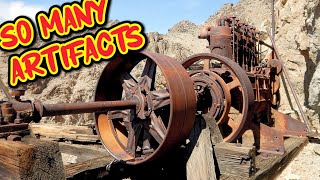
Further down the hillside, a decaying wooden platform supported a massive 4-cylinder engine used to drive belts. To what we could not determine, as the drive pulley didn't seem to align with any other equipment on the mine. Still, it was a huge piece of equipment, and must have done a lot of work for the miners here.

The main shaft on this old 65hp Type C Aurora Engine still spun freely!

The cylinder head valve train was fun to see, since we rarely get to see the valve springs and rocker arms on modern engines.

Number 951.
Following an older miner's trail - I always love finding these amazingly old trails, still visible hundreds of years later on the desert floor - back up the hill, I admired some of the artifacts that were left by the miners when they finally abandoned the site.


A huge auger bit, perhaps for drilling footings in softer terrain [of which, there wasn't much up here]. (left) | An awesome old wooden pulley on the headframe. (right).


An old shovel head and what might be an aerial ore cart yoke? (left) | An old pulley wheel of some sort, looking out over the wash below. (right)


An exposure of the quartz seam that was the bread and butter of this old gold mine. (left) | A chunk of ore with copper staining. (right).
Eventually, I couldn't delay any longer. Not that I was scared of the definitely-not-sketchy-looking descent down the inclined shaft. Everything would be fine, I'm sure. Probably. And so, after dropping off a bunch of the camera gear and electronics I'd been carrying around with @mrs.turbodb, I took my first tentative steps into the darkness.
I wasn't moving quickly. I'm not usually a let's-test-out-the-ladders guy when it comes to mine exploring - I prefer to wander within a mostly-level adit - and the fact that this ladder seemed to get both steeper and less-well anchored the further it extended down the shaft, the more I wondered if this was my brightest of moments.

I don't know if this view is technically any more dangerous than wandering into an adit, but it sure got my adrenaline going.

Almost immediately the shaft opened up into a huge stope, with the quartz vein still visible along the far wall.

I survived!
For a more in-depth (literally) exploration of this mine, check out Tom and Julie's exploration of it. There was some good stuff in there that I missed, but I'm OK with that!
Watch on YouTube.
Back top side, it was nearly time to start back down toward the Tacoma when we noticed an out-of-the-way post with a conspicuous-looking jar sticking out of an old tin can. Knowing that this could be the paperwork for the mine, but ready for the jar to be empty, we carefully extracted it from the can and were thrilled to see papers inside.
They were old, brittle, and definitely worse for wear, but super cool to lay out and admire.

Socked away in a jar for longer than we've walked this earth.
And then, it was time to go. Our descent down the steep canyon would be quicker than our climb. There are some who prefer the downward direction, but I'm not one of them - it's much harder on the knees. My grandpa always regaled us with stories of walking uphill - both ways and through snow(!) - to school, and as a hiker, I think that sounds like a pretty sweet deal.

Can't complain about the views of the dunes on the way down.

The largest arrowhead I've ever found.

As usual, we did our bit to pick up after the bozos who keep buying these things.
An hour later, we'd left the canyon far behind, and had less than a quarter mile to the Tacoma. There, we'd guzzle a bit of water and pushed the A/C lever to max as we pointed the truck towards our next destination; another mine, not too far away.
It was a location that I'd been asked if I recognized by the same person who'd helped me find the mine we'd just explored. In fact, I had recognized the view - having seen it on one of my first hikes in Death Valley - and before long, we were both making plans to visit.
Rumor had it there was an ore cart. On rails. That moved.
The Whole Story


Those valleys are full of endless delights. We made a second trip after the November rains to find Greenwater Valley full of shimmering streams and the Amargosa River full of chocolate brown water. We hiked over dozens of braided streams to reach Ibex dunes, and the second day up onto Buckwheat dunes which were still wet, the sand like pavement. We had an absolutely glorious time!
Sounds fantastic! Those dunes are so often void of prints, so they are always a pleasure to explore. Wet sounds even more fun!
That "purple" night sky could be the aurora as that night was a major event. A photographer I follow was at Topaz Lake that night and it was pretty bright there.
Neat mine and cool equipment. Photo from down the shaft, hmmm. Next you and @mrs.turbodb will be riding in an ore cart escaping the bad guys.
https://www.flickr.com/photos/jeffreysullivan/54920018475/in/dateposted/
Oooo, I wonder if it was the aurora. I've never (knowingly) seen that before, and I always think of it as being green.
As for riding in ore carts - that would be fantastic! Please sign us both up, and if I can't get @mrs.turbodb into the mine, I'll take her ride! 😉
My wife grew up in Wisconsin and would always complain when they showed green auroras, said she saw them with reds and purple.
You know one of the Indy movies had that ore cart scene. 😁
Yeah, I'd second the guess of aurora. Most of the more southern folks who saw aurora recently photographed as red or purple. Some cameras (and most phone cameras) don't have an IR/UV cut filter, so they're more sensitive to those colors than the human eye, and can gather light over time to make the colors more apparent.
The alternative is just sky glow, which is ionized air in the upper atmosphere. But those seem to me to be greenish.
Once I figured out those were the setting Pleiades in your photo, I could determine you were shooting to the northwest, before dawn. Maybe a waning crescent moon to illuminate the foreground. That would make sense for aurora. Nicely done!
I haven't managed to be somewhere dark during an aurora outbreak. Some Milky Way with skyglow (the greenish glow) shots I took in Chaco Culture National Historical Park, in June, are in this post.
Nice sleuthing on the conditions of the shot, you got it 100% correct on all counts! 👍
And boy, those are some fantastic Milky Way photos. Definitely put the few I've gotten to shame.
Another great trip, thanks for sharing.
Thanks Kenny!
Cool artifacts! Always fun to see that stuff.
So true. Always fun to find places that are remote enough that they haven't been completely picked through!
My granddaughter (she was 13 at the time) and I took the shortest route in. Some of the washes were big enough to hide a 747! We made it across in about 55 minutes on the way in, and about an hour and ten on the way out. We were pretty tired, and a few of the drop-downs were tougher to climb back out of.
I’m really glad you found the wheel — we missed it, and I was worried either Mother Nature or looters had gotten to it. It actually took me two trips to make it out there. The logbook entry you read a few days later was written when I had food poisoning. I kept trying to get up and make the hike until about 9 a.m., but it just wasn’t happening.
I messaged home base, checked my granddaughter’s school schedule, and planned a second trip instead. That one worked out much better.
Thanks again for the tips on the mine; we very much enjoyed it, and getting back into the desert!
I'm not sure I've ever mentioned this, but I also think it's awesome that you get out and explore with your granddaughter so much. That's gotta be a ton of fun, and so great for her to get out to explore (and hopefully enjoy).
Same granddaughter rode in the ore cart you find in an upcoming episode. She's the one that likes hiking the most, but I try to get out with all of them (there's 5) when I can. I just did the Tecopa Mines tour with the oldest grandson. Same granddaughter and her younger sister helped me find a wagon that I know you're excited to tell us about. It's more fun with them exploring, but they all live farther away now so it's tougher to line up schedules.
Thank you for great photos & comentary, one of your best! I love Death Valley and it's back roads. Myself & some friends used to spend about a week there every Thanksgiving for about 15 years. It has been a few years but hope to get back soon to do more exploring with my Jeep, but I am too old & fat to hike.
Thanks again,
Rick
Glad you enjoyed it Rick! Getting into the park, however best suits you, is always a win in my book. Hope you're able to get back soon!