
Perched along Whisky Ridge, we hoped that the cool breeze blowing through the tent would sweep away some of the smoky haze that had accumulated the previous afternoon. Alas, we had no such luck, evidenced by the orange glow extending far from the horizon as the sun worked its way into view.


Knowing that it'd start to get warm quickly as the sun climbed into the sky, and that we had nearly 150 miles of mountainous terrain to cover between our current location and the spot we hoped to call home the next morning, we were both down the ladder only a few minutes apart and decided to wait on breakfast so we could enjoy and early morning traverse down the length of Whisky Ridge.


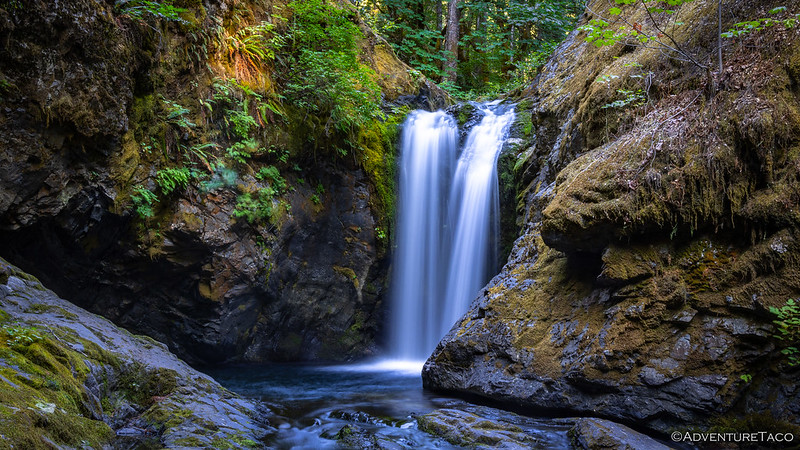
Over the first 15 miles of the day, we dropped more than 4,000 feet as we crossed from Oregon to California, the skinny pedal used only rarely, our gas mileage nearly infinite. It was prime time for deer, and several of them bounced quickly out of the way, our approach masked by bends in the road. Ultimately, we found ourselves along side the Middle Fork of the Applegate River - only a few miles from where we'd turned north the previous afternoon - when @mrs.turbodb mentioned a waterfall she'd found on Gaia.
Nothing of the sort was shown on my Backcountry Navigator XE maps, but this is a great reason to use more than one route planning tool, and after a bit of nosing around in the woods along various camp site spurs, we found one of the nicest, most private waterfalls we've seen in quite some time.


To both our surprise - and despite all the water - there were no mosquitoes intent on destroying the peaceful oasis, allowing us to spend nearly 15 minutes hopping amongst the rocks, contemplating a morning dip, and playing around with exposure settings. Eventually though, it was time to continue deeper into California - towards Seiad Valley and our second river of the day, the Klamath.

Before reaching the Klamath River, we had one more pass to climb - Cook & Green Pass. As with much of the previous day, this section of our route was intertwined with the Pacific Crest Tral (PCT) and there were several points at which we slowed to a crawl in order to reduce our dust profile, as we passed hikers already huffing and puffing as they tried to take advantage of the morning cool.


We'd planned to stop for breakfast at Horsetail Falls, but another Tacoma was already there when we arrived. Turns out that the driver was performing support crew duties - which included delivering breakfast-by-a-waterfall - for his girlfriend who was hiking north on the PCT, a pretty good gig if you can get it!


From Cook & Green, it was another 3,000-foot drop to the town of Seiad Valley, where the route turned to pavement for a few miles as it followed the Klamath River downstream.
I hadn't given much thought to fuel along this route. At only 3500 miles, I figured that a full tank and two Scepter Jerry Cans would be plenty - but when presented with the option to take advantage of an unexpected service station, we played it safe and filled up anyway. It was a good thing we did, because as I was watching my life savings transfer out of my wallet and into the gas tank, I got the most amazing voice mail from my uncle...

I played the message for @mrs.turbodb as we headed west along CA-96, wondering if we might just run into a tan Sportsmobile as we followed the Klamath for the next several miles. Of course, we had no such luck, though we did find a nice shady spot - at Fort Goffs - to pull over and have breakfast.


As fate would have it, there happened to be a phone booth near the far end of the parking area - actually the Fort Goff campground, though we found no camp sites - and on closer inspection, it was the strangest phone booth we'd ever seen.

With the same area code as much of rural northern California, I figured a quick call was worth a shot. And you know what - local calls were in fact free!

Turns out my uncle was several hours east of us, curious to see one of the four dams that are going to be removed from the Klamath over the next several years, restoring it to a more natural state and allowing the fish that once spawned here to slowly return. That meant we wouldn't get to meet up, but it was a fun conversation nonetheless, each of us wishing each other happy trails as we explored the same tiny little slice of the world!
Soon enough we were back underway, the route turning north as it climbed away from the Klamath River and back onto the ridgelines, the smoke from the Flat Fire getting thicker as we headed toward the source.


Working our way along Thompson Ridge, we soon found ourselves driving through a much more recent burn as we approached the former site of the Bolan Mountain Lookout. Here, in 2020, the Slater Fire roared through 166,127 acres, claimed the lives of two firefighters, and injured another 12 people.

It was nearly 1:00pm when we arrived at the locked gate at the bottom of Bolan Mountain. Like the Acorn Woman Peak Lookout we'd found the previous day, the Bolan Mountain Lookout could be rented from the USFS prior to its demise. Today, only the concrete footing survives, and the views are much starker than they once were. Still, we were curious to see the aftermath and a little walking would do us some good. So, having eaten a late breakfast - neither of us were all that hungry - we decided to we'd hike the lookout before heading down to Bolan Lake for lunch.


Our jaunt to the lookout a success, we were hot and hungry by the time we returned to the Tacoma and found a spot along the edge of Bolan Lake for lunch. The water turned out to be a bit stagnant - green algae a little too thick for our tastes when it came to swimming - but a shady picnic table was the perfect place to prep and devour a turkey sandwich and a few more of shockingly orange Cheetos, which I submit are covered in addiction powder.

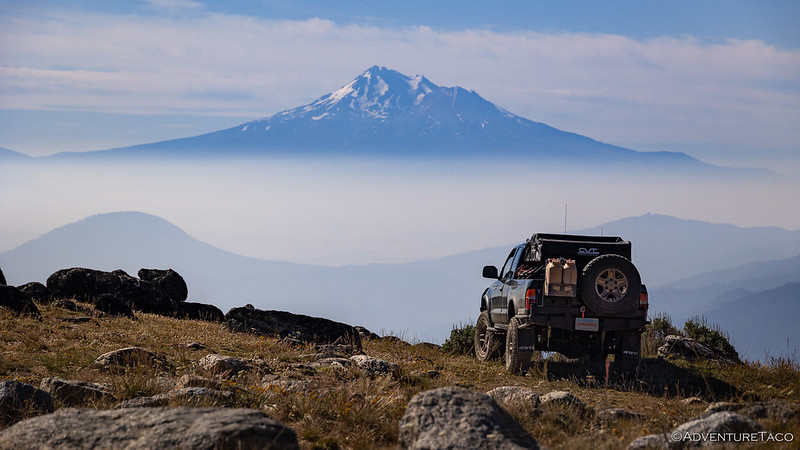
I'm not sure how it happened, but even with the early start we'd gotten, we still had more than half of the 150 miles to cover when we pulled away from Bolan lake and headed towards the eastern edge of the Kalmiopsis Wilderness. And so, we did what any good explorers in our situation would do: @mrs.turbodb nodded off for her after-lunch nap, and I tried to refrain from stopping for photos. Naturally, only one of us was successful, and I got some great photos!


By 4:30pm, we found ourselves at the base of Eight Dollar Mountain - a rather strange name originating from either the nearby discovery of an $8 gold nugget or as the result of a feud between two miners, wherein a bet was made that one of them could not walk around the base of the mountain in a single day. Determined to win the bet, the man purchased an $8 pair of boots before completing the task and winning - you guessed it - $8.
Personal note: Even though he "won," it seems he didn't think that one through fully.
We also found ourselves at the Eight Dollar Mountain Botanical Garden, where a quarter-mile boardwalk would lead us to what was described as one of Oregon's "most unique botanical features, a wetland fen." This was certainly something we were game for, and a few minutes later we were gazing on a field of California Pitcher Plants.

Ultimately - having been exposed to these carnivorous monstrosities throughout most of my childhood in the Plumas National Forest - I found this rather mundane. Mentioning as much as we climbed back into the car and started towards the Kalmiopsis Wilderness, I discovered that, apparently, I was the only one who felt that way.
After crossing a historic steel bridge - on which I can find scant information as to its importance - It took nearly an hour to climb 3,000 feet to a ridge that overlooked the Kalmiopsis Wilderness.


Unlike the botanical garden - where our opinions may have differed - neither of us was impressed with the 20-mile roundtrip to a rather mundane view due to the lack of visibility. With it getting late - and with two more hours of driving before we'd reach our planned stopping point - we had a quick discussion about camping here, despite the smoke, since at least the temperatures were a little more reasonable than the were in the lowlands.
And then, we headed down.


Our sights now set on Chetco Pass, we followed the Illinois River as it flowed north, then west. We weren't the first to wander this way, the river banks covered in 30-foot tall tailings piles, and sign after sign warning us not to trespass on active claims.

The road to Chetco Pass was described thusly in Oregon Byways:
The road from FR-4103 down to McCaleb Ranch can be an adventure in itself. Winding around a rocky switchback and down to the water's edge, the road crosses a low-water wooden bridge that is inundated when the water is high. McCaleb Ranch, a pioneer settlement now owned by the local Boy Scout Council, occupies the large flat on the far side of the river. If you camp in the vicinity, respect the peace and solitude of the caretakers.
The road to Chetco Pass, straight ahead and uphill, is sometimes gated, though usually not. It is exceptionally steep, with long, precarious drop-offs, and ruts that will swallow your vehicle if you fall into them rather than straddle them. But Chetco Pass is fantastic, with woods, meadows, and serpentinite outcrops.
The gated road beyond the pass leads to some chromite mines inside the Kalmiopsis Wilderness. The road right, up the hill, will take you halfway to the summit of 5,098-foot Pearsoll Peak, highest point in the Kalmiopsis.
Most people hike to the summit from Chetco Pass because the road up from the pass is even worse than the road up from the river.
Except that we were in a race against the sun, that description seemed fantastic - just the kind of place that we were likely to have to ourselves, and the perfect spot to begin the following day with a hike to the summit of Pearsoll Peak!


It turned out that the road to Chetco Pass was just as nice as every other well-graded gravel road we'd driven on to this point in the adventure. Sure, there were some drop-offs that were unsurvivable, and the smoky air certainly didn't do our lungs any favors - but there was little-to-no risk that one would venture close enough to the edge for the drop-offs come into play, making the AQI of 214 a much more dangerous risk.

We reached the pass at 7:48pm, still 45 minutes before sunset, but just as it'd dropped below Pearsoll Peak and the Kalmiopsis Ridge to our west. At 3,641 feet, the smoke - which had been getting worse all day - was thick enough to taste as we deployed the tent and got started on dinner. Surely, I mused, everything we owned would smell like campfire when we returned home, a situation we generally try to avoid.


As the light slowly left the sky we both took the opportunity for a quick scrub down using a washcloth, our faces covered in sunscreen and our bodies covered in the smell of 3-days-unshowered-human. I'm not sure it did much good with the smell, but hey, in no time we'd probably smell like chain smokers anyway.

I have to admit a small bit of disappointment as we climbed up the ladder for our last night on the trail. With the wind blowing from the northwest, it seemed as though every bit of smoke the Flat Fire could muster was headed in our direction.
I only hoped that the following morning - when we set out for Pearsoll Peak - that we'd be able to see something in the direction of the Kalmiopsis Wilderness. Because if not, I wondered if we should just head home...

Even though we weren't able to meet up, it was fun being in the same part of the world and exchanging stories. UJ
Definitely! Would have been super cool to get together, but there will be more opportunities!
Fort Goff Camp
"All campsites are walk-in, 20-75 feet from vehicle parking."
Looks like they tricked you! Not great for truck camping though. Great report as always.
We weren't ever planning to camp there (it's right on the road), and we did discover the trails to the "camp sites" (which were really just picnic tables - there weren't even any flat areas for tents), but mostly we just thought it was funny to have a parking lot marked as a "campground."
There is plentiful dispersed camping in the area that is way better than Fort Geoff, so it's no surprise that it's not amazing. 😉
For those of us who live in the more arid and dry climates that you favor these green foresty trip reports are gold!
Thanks Joseph! I love the green forests as well, as long as I'm not stuck in tree tunnels! A view every now and then - so I can see the trees in the context of the mountains - is all I need! 😉 Glad you're enjoying the story, more to come on this one in the next couple of days.
Much love and respect… I do waaaay 2 many road-trips not like yours but definitely I’ve been in places that you’ve been. I’m a big fan of Northern California I was at Lassen for few days and camped in manzanita lake for 3 days w/o any other person near by… keep up brotha I hope I can meet you one of these days…
For now enjoy
Thanks Cesar, glad you're enjoying the stories and photos. It's pretty awesome there in NorCal. If you enjoy Lassen, you might want to check out this trip: Lassen National Forest Discovery Trail (Jul 2022)