Having made the decision to eat lunch at the top-rated restaurant in town - technically, the Conoco gas station - we glanced at each other as we entered the establishment to a sign notifying us that the wait time was upwards of twenty minutes. Sure that this must be the time for to-go orders - as opposed to priority customers that opted to eat there - we grabbed a table and quickly homed in on the special - Huck's Burgers.
Top tier St. Regis eatery.
Placing our order, we were sure that our starving stomachs would be imminently satisfied, but first five, then ten minutes passed, with no indication that progress was being made on our patties. As we waited, I bemoaned the price of a soda - $4.25. For a fountain soda. In a gas station. Which is a bit like getting mugged inside a police station. Then I remembered the convenience half of the same store would refill my 40oz Beast for a mere $1.29, and I strutted over there like I'd just outsmarted the entire establishment. Because I had. I saved three dollars, and for the next few minutes, I was insufferable about it.
Huck's hack. Apparently even Codex (AI) thinks the stainless steel tumbler is epic.
Prouder of myself than was probably warranted, we waited another 17 minutes for our burgers and fries. Had we not had another full stage of the BDR to complete before dinner, we probably wouldn't have been quite so critical, but when the first bite of burger revealed microwaved meat, we weren't exactly the happiest of diners. On the flip side, the fries were pretty tasty.
Having waited as long as we did - and given how hungry we were - even the mediocre meal was quickly consumed. And then, right around 3:30pm, we were on our way from St. Regis, toward Thompson Falls.
Well, this sounds splendid!
It didn't take long to realize that the promised "Paradise" was from a perspective other than ours. Perhaps pine beetles would find the endless tree tunnels something to get excited about, but for us - after a morning of the same - it was starting to feel like the northern half of the Montana Backcountry Discovery Route didn't have much to offer. It was a feeling that - unfortunately - would persist through the remainder of the day, and well into the next.
But I'm getting ahead of myself, there will be plenty of time to dwell on the terrain!
An hour later, we'd covered nearly a third of the 68-mile stage as we crested a ridge a few hundred feet below Camels Hump Lookout. This was a place we were excited to visit - it was a staffed lookout and we were hoping to share some of our patriotic peanut butter cups!
But then - as had been the case at all but one lookout so far - a gate across the road. A mile below the lookout, the problem wasn't getting there, it was getting there with uneaten peanut butter cups. And of course, there was the little issue of time constantly nagging at the back of our brains.
This was the point where I needed a drone with a tiny cargo basket, a payload release, and possibly a little parachute - a Reese's airdrop. A morale boost to the often-thankless outposts of the Forest Service.
Without a delivery device, we flew our little buddy up empty and ate the peanut butter cups ourselves. For America.
Camels Hump Lookout - with its ring road - was one of the more beautiful lookouts we didn't ever see, and soon enough we were back under way, speeding through a tunnel of trees.
Every now and then, a clearing. Of the chainsaw variety.
In and out of the shade, variations in light were one of the few distractions. Over the next few hours we descended from Camels Hump to Henderson, then headed back into the mountains. At which point we dropped back down - to essentially the same elevation where we'd started the stage - in Thompson Falls.
The light - as we crested a ridge - was good enough for a quick stop.
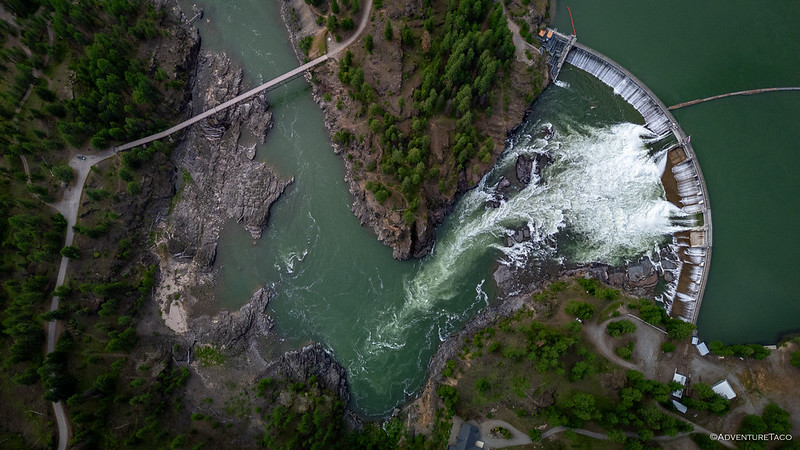
Three hours after leaving St. Regis, we backed the Tacoma into a space in the completely empty lot for the Thompson Falls Dam. From there, a bridge led us to an island, where the roar of water through the spillway was deafening. It was the perfect day to visit - surely this place is generally packed with people - and we had the entire island to ourselves!
Thompson Falls Dam.Closer.
More water passes through Thompson Falls than any other dam in the Montana system. The highest known flow was recorded in 1948 at 163,000 gallons per second, beating out the Missouri River, which maxed out with 126,000 gallons/second at Big Falls during a flood in 1908.
Spillways.Bird's eye view.
Although electricity was a relatively new technology at the turn of the 20th Century, electric lights and machines quickly became popular. In addition to its use in homes and industries, electricity was needed for construction. But in a region without power, where would the electricity required to build the dams and powerhouse at Thompson Falls come from?
To provide initial power to the area, the Prospect Creek generating facility was built in 1912-13. Look across the Clark Fork River and you'll see the foundation remains of its powerhouse at the mouth of Prospect Creek. The Prospect Creek facility supplied power for the lights, compressors and pumps used to construct the much larger Thompson Falls Project, which began generating its own electricity in 1915. The Prospect Creek power plant also brought the first electricity to Thompson Falls, Plains, Paradise, and other Clark Fork Valley locations. Customers paid $2 monthly for 110-volt service that could be adjusted to light several light bulbs.
Powerhouse.
To make electricity at Prospect Creek, water was diverted into a wooden flowline at a small dam, about 1 mile up the creek. The flowline carried the water to the top of the hillside above the powerhouse, where it dropped through a penstock. The force of the water falling to the powerhouse spun a Pelton waterwheel, which was connected to a generator.
Although the Prospect Creek power plant produced little electricity by today's standards, it was enough to meet the region's first power needs. High water flows in the Clark Fork River during spring runoff caused problems at the Prospect Creek facility, and it was decommissioned soon after the Thompson Falls Project came online.
Info Sign
The dam had been significantly more interesting than I'd thought it would be.
Heading back to the Tacoma, we'd finished our second stage of the day. With two remaining before we'd reach the Canadian border, we pointed the Tacoma out of town to find a place to sleep. Two stages down, two to go, and a growing suspicion that the entire northern half of this route had been designed by someone who really, really loves trees and couldn't care less about a view.
I think a bad day on the bdr is better than a day at work!
I agree with you, we are all looking for exitment and sometimes the road is boring.
You said you like Idaho bdr but for us the north sections , in the forest were boring.
I am thinking of a section of Wy bdr, Lander to Shoshone, not one tree but beautiful views.
This is the first year of the MT bdr, may be they could adust the route to make it more exiting.
Also BDR should not be a Cannonball race, i like the many alternate location you are visiting.
Gosh, a microwave burger, the worst!
turbodbAugust 16, 2026
Well, for me, work was always something I looked forward to, but I know that's not the case for everyone. And of course, I do definitely look forward to every night in the tent as well, so I do agree with you, too!
The northern section (last stage or two) of Idaho wasn't the strongest of its showings, either, and I think part of what you're seeing bleed through in this stage 6 report is my knowledge of stage 7 and 8 as well, lol, as well as lots of experience exploring other, northern parts of Montana that were so much nicer than the BDR route through that part of the state.
SkyhikerAugust 14, 2026
Congrats on the soda victory!
I, myself, was insufferable earlier this week over the free set of T-mobile cooking tongs I scored on T-mobile Tuesday. 😀
turbodbAugust 16, 2026
Hahaha! It's the little wins that make life so fun! 😁
Francois and Ellen BeraudAugust 16, 2026
May be the BDR staff is reading your post and will make some changes next year.
Usually you are gung ho, i could tell it was not he case this time!
May be the BDR people are reading your post and we make some changes .
My wish will be more mountain stages and more Big sky country views
I also drive a tacoma , but used to ride bike . Last one was a Yamaha 500 xt with a 590 kit etc... my dream was to do the Dakar!
For us truck drivers we like more view and more technical stuff . for this category of road i use Overland trail guide.
For Bikers reading this; this road is nice and easy, take your time, go visit the fire lookouts.
But i do support BDR.com and each time we do a route we make a contribution and thank them for the fun.
Tomorrow at this time we will be in the Inyo Mt., Mountains you know very well.
Andrew PangleAugust 17, 2026
lol, I was there yesterday and saw that 20 min sign…. I just got a $5 burger at the register and walked over to the dog park across the street. It was…. Also terrible




I think a bad day on the bdr is better than a day at work!
I agree with you, we are all looking for exitment and sometimes the road is boring.
You said you like Idaho bdr but for us the north sections , in the forest were boring.
I am thinking of a section of Wy bdr, Lander to Shoshone, not one tree but beautiful views.
This is the first year of the MT bdr, may be they could adust the route to make it more exiting.
Also BDR should not be a Cannonball race, i like the many alternate location you are visiting.
Gosh, a microwave burger, the worst!
Well, for me, work was always something I looked forward to, but I know that's not the case for everyone. And of course, I do definitely look forward to every night in the tent as well, so I do agree with you, too!
The northern section (last stage or two) of Idaho wasn't the strongest of its showings, either, and I think part of what you're seeing bleed through in this stage 6 report is my knowledge of stage 7 and 8 as well, lol, as well as lots of experience exploring other, northern parts of Montana that were so much nicer than the BDR route through that part of the state.
Congrats on the soda victory!
I, myself, was insufferable earlier this week over the free set of T-mobile cooking tongs I scored on T-mobile Tuesday. 😀
Hahaha! It's the little wins that make life so fun! 😁
May be the BDR staff is reading your post and will make some changes next year.
Usually you are gung ho, i could tell it was not he case this time!
May be the BDR people are reading your post and we make some changes .
My wish will be more mountain stages and more Big sky country views
I also drive a tacoma , but used to ride bike . Last one was a Yamaha 500 xt with a 590 kit etc... my dream was to do the Dakar!
For us truck drivers we like more view and more technical stuff . for this category of road i use Overland trail guide.
For Bikers reading this; this road is nice and easy, take your time, go visit the fire lookouts.
But i do support BDR.com and each time we do a route we make a contribution and thank them for the fun.
Tomorrow at this time we will be in the Inyo Mt., Mountains you know very well.
lol, I was there yesterday and saw that 20 min sign…. I just got a $5 burger at the register and walked over to the dog park across the street. It was…. Also terrible