
Having gotten horizontal before just after 6:00pm the previous evening, I figured it wouldn't be hard to get up by 5:00am and hoof it a few miles up the North Fork of Trail Canyon - to Aguereberry Point - in order to capture some sunrise photos.
Right.
Fumbling frantically for the "turn off you stupid thing," button when my alarm went off, we proceeded to sleep another two hours until our internal alarms - err, bladders - just couldn't take it anymore.

Knowing that there was no way we could complete three Trail Canyon hikes with only 9 hours of daylight - each hike was between 3 to 6 miles long and entailed 1,000 - 2,900 feet of elevation gain - we immediately removed the north fork trail from our "to do" list, relegating it once again to the "left behind" pile. Again.
At this point I suppose we could have just admitted defeat, but being rather stubborn, we decided to skip breakfast and tackle the shortest of the hikes - up the main fork of Trail Canyon to the Smith and Polson Camp a couple miles away.

Not only was this the shortest hike, but it also turned out to be the easiest from a terrain perspective. The canyon remained wide and an old road - no longer drivable given the area's wilderness designation - made hiking easy. We stopped only a few times to marvel at the geology of the canyon walls, before reaching the first adit.


The adit - only about 75 feet deep - was interesting in that the walls were canted at a relatively steep angle - matching that of the layers of rock in which it was excavated, I suppose - and were surprisingly smooth.


Smith and Polson's Ronald "A" No. 1 Mine and Ronald "A" No. 4 Mine were Tungsten operations that saw little success. Within a couple hundred feet of each other, the No. 1 mine worked a nearly vertical vein of tungsten-bearing milky quartz using a unique - to us - contraption that appeared to be a stationary dredge with tiny buckets. This contraption has fallen down, but it was still fun to figure out how it worked and wonder about its effectiveness.


This was as far as we'd planned to explore this central fork, we booked it back down to camp where @mrs.turbodb made an early lunch - it was only 10:30am or so - while I broke down the tent and got the Tacoma ready for travel. Half-an-hour later, we were headed down canyon toward the south fork, where we'd end up spending the vast majority of our day!

Unlike the North and Middle Forks of Trail Canyon, a road climbs the first couple miles of the South Fork to the Morning Glory Camp. This road isn't the smoothest - high clearance, 4WD is a must - but we were glad for it regardless given that even after reaching the camp at the end, there was still a 2.5 mile, 2,100 foot climb to reach the mine itself!


 .
.
(I don't always try to duplicate photos that Digonnet has in his books, but in this case, I have to admit trying.)
Built on a long bench above the wash, Morning Glory Camp is relatively well preserved and still has several standing structures. One of them is a small cabin, furnished with a bed, cupboards, and shelves. It even has a separate (non-functional) bathroom with a sink and toilet.
There is also a long, wooden, green bunkhouse with a stone fireplace and an eclectic mess of furniture, a headframe, and an open shed with work benches.
The carcass of a 1950s-vintage Dodge is resting on a heap of rusted cans, its chrome grid grinning in the sunlight. At least one good-sized flashflood has ripped through this fork since the 1950s. It severed the frame of a small truck, now largely buried under gravel in the middle of the wash.Hiking Death Valley


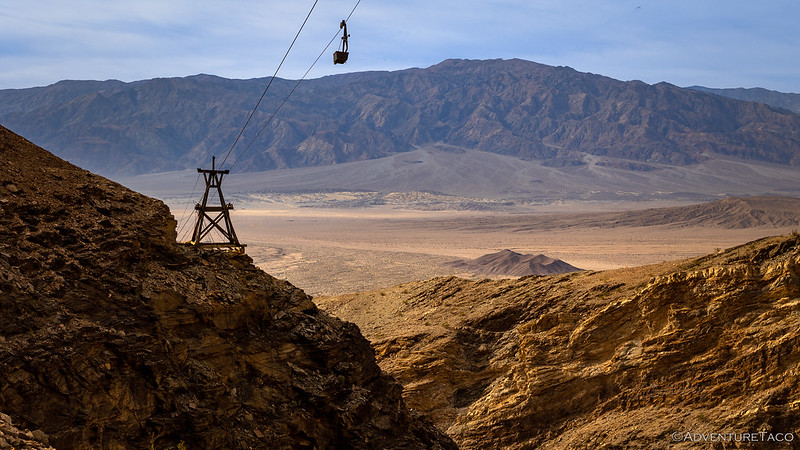
Exploration of the camp complete, it was time for the main attraction of the day - the trek to the Morning Glory Mine itself. This was a hike I'd been looking forward to for some time - even more so after talking to Jeremy the previous afternoon - as the descriptions I'd found promised more aerial tramways, mining cabins, and colorful ore over the course of the 5 mile loop that would see us reaching elevations of 6,400 feet!

The first mile was easy going. The wash - as with the main fork earlier in the day - was wide and though we had to avoid the plentiful desert shrubs, finding a path wasn't difficult at all. We stopped from time to time as interesting finds presented themselves, eventually reaching the Old Dependable Antimony Mine after a little less than an hour.


About 60 feet above the wash, the wooden ore bin and chute cling precariously to the hillside. Active from 1939 to 1941, the mine produced about 70 tons of high-grade Antimony ore before operations were suspended during World War II. It was opened again in 1949, but there wasn't enough high grade material to sustain more than a few months of operation.
An old road still circles up to the platform and workings, allowing us easy access to the site. Unfortunately, both adits have collapsed, leaving only the deteriorating wooden structure and a Buda generator for us to admire.


Just above the Old Dependable Mine we had a choice to make - we could either head up the old mining road, or we could take the more adventurous route, up the
Trail Canyon Canyon Trail 
Having loved the canyon trail to the Keane Wonder Mine, we opted for the latter, knowing that the old mine road would likely provide grand views on the return leg of our route.

It was amazing how quickly the terrain changed once we passed the mining road that shot steeply up the mountains. The Trail Canyon Canyon Trail narrowed considerably - in places, the walls only an arms length apart - and the grade increased dramatically. Our previously reasonable pace slowed as we negotiated dry falls, bushwacked through pinion pine, and clawed our way up fields of scree that threatened to send us sliding back down to the canyon floor.


There was only one fall that we found impassable, requiring us to climb out of the canyon to bypass it to the southeast. Luckily, this task - made more difficult given the steep scree field we had to negotiate - was assisted by the old tramway cable that lay on ground, allowing us to stabilize ourselves across the treacherous terrain.


The reward for all this work - and let me tell you, the progress was slow at well under one mile per hour - was worth it. All along the way - especially where the tramway had crossed the canyon - we'd seen quartz laced with deep blues and greens. I don't generally associate these with Tungsten mining - the focus of the Morning Glory Mine - but they must have been, and they were beautiful.


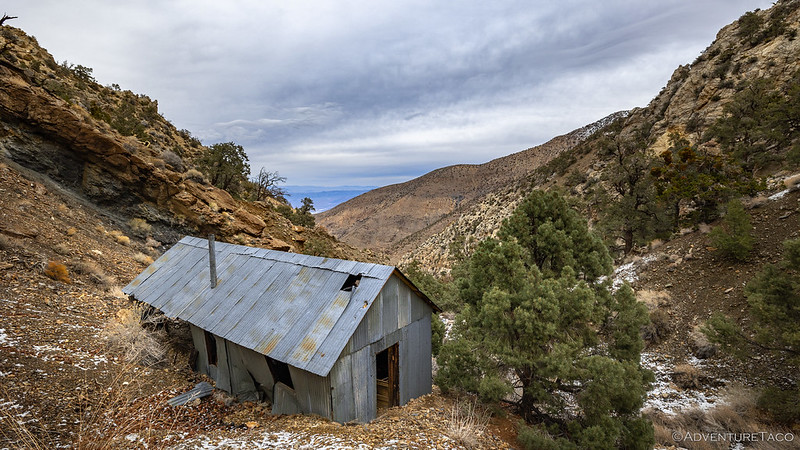
And then, as we climbed the final dry fall, we spotted the mine itself, nestled into the steep ravine. An ore cart rusted below a pile of waste rock that was carved out of the hillside. Above it, a short section of track, an adit, and of course the shed where the miners ate, slept, and sought shelter from the elements.


By now, it was three hours after we'd set out and with the canyon trail being the more direct route, we had an even longer descent in order to return to the Tacoma. Our hope - that the road would be easier to navigate than the trail-less canyon - played out in the end, and additionally allowed us to enjoy views that stretched all the way across Death Valley as we shed elevation.


Still, we didn't reach the trailhead until nearly sunset. We'd spent the entire day in Trail Canyon - much longer than I'd anticipated for such (relatively) short hikes - a reality that I hadn't planned, but that felt rewarding, nonetheless.
Now in the Tacoma, we worked our way back to through the confluence to the mouth of the canyon as darkness blanketed the Panamints. By the time we found a site - out of the main wash given the last forecast we'd seen a few days prior - we were both exhausted and it was time for bed.


With one more full day of exploring - and having explored only one of five canyons on my itinerary - I found myself wondering as to the best path forward. I had no idea at the time, but nature would make that decision for us.

Dan,
That stationary dredge is usually called a bucket elevator in the industry. They are built all kinds of different ways with different bucket materials and chains depending on what is being transported (lump size and abrasion are issues). There are drag conveyors that are similar and work at different inclines from I suppose 30 deg incline to very steep angles. I know nothing about them but they look very similar to your bucket elevator.
Nice work as usual.
Nice, thank you for the info on the bucket elevator. I'll dig a little bit into them, but I assume that they aren't actually digging themselves - like a dredge - but are rather fed with material that is then lifted into the rest of the apparatus for processing?
This contraption looked to be stationary when it was in operation.
Yes, all that I have seen are permanently anchored to a foundation and the bucket elevators are constructed as vertical as possible. They are designed to be fed a consistent mass flow of material, that leaves some unused volume in the buckets but reality being what it is sometimes they have to dig. That is hard on the machine but if it is powder probably no problem, if it is chunks of ore you usually trip the motor and you have one hell of a mess. I freaking love materials handling equipment but I only have dealt with 20-30% of the total spectrum. Feel free to ask me any question you have.